I’m standing outside Sainsbury’s wondering which, if any, of the people here might be waiting to join my pavement plant walk this overcast October afternoon. I wasn’t sure how popular an urban plant walk would be at five on a weekday, so I’m delighted when six others do arrive.
I start by explaining that this particular walk is part of London Wildlife Trust’s Autumn Festival of the Great North Wood. The focus of the Great North Wood project, I say, is mostly on green spaces as you would imagine, but you can find wonderful wild pavement plants in the built-up parts of its historical footprint too. I tell them that I’m hoping through walks like these to share my passion for urban plants with as many people as I can reach. I absolutely love finding beautiful plants tucked away in urban corners, many of which originated from far-flung parts of the world and I really believe that once you’ve started noticing them it changes the way you see and feel about our city streets for good. And for me personally, pavement plant hunting in autumn and winter is the best antidote for waves of seasonal adjustment disorder.
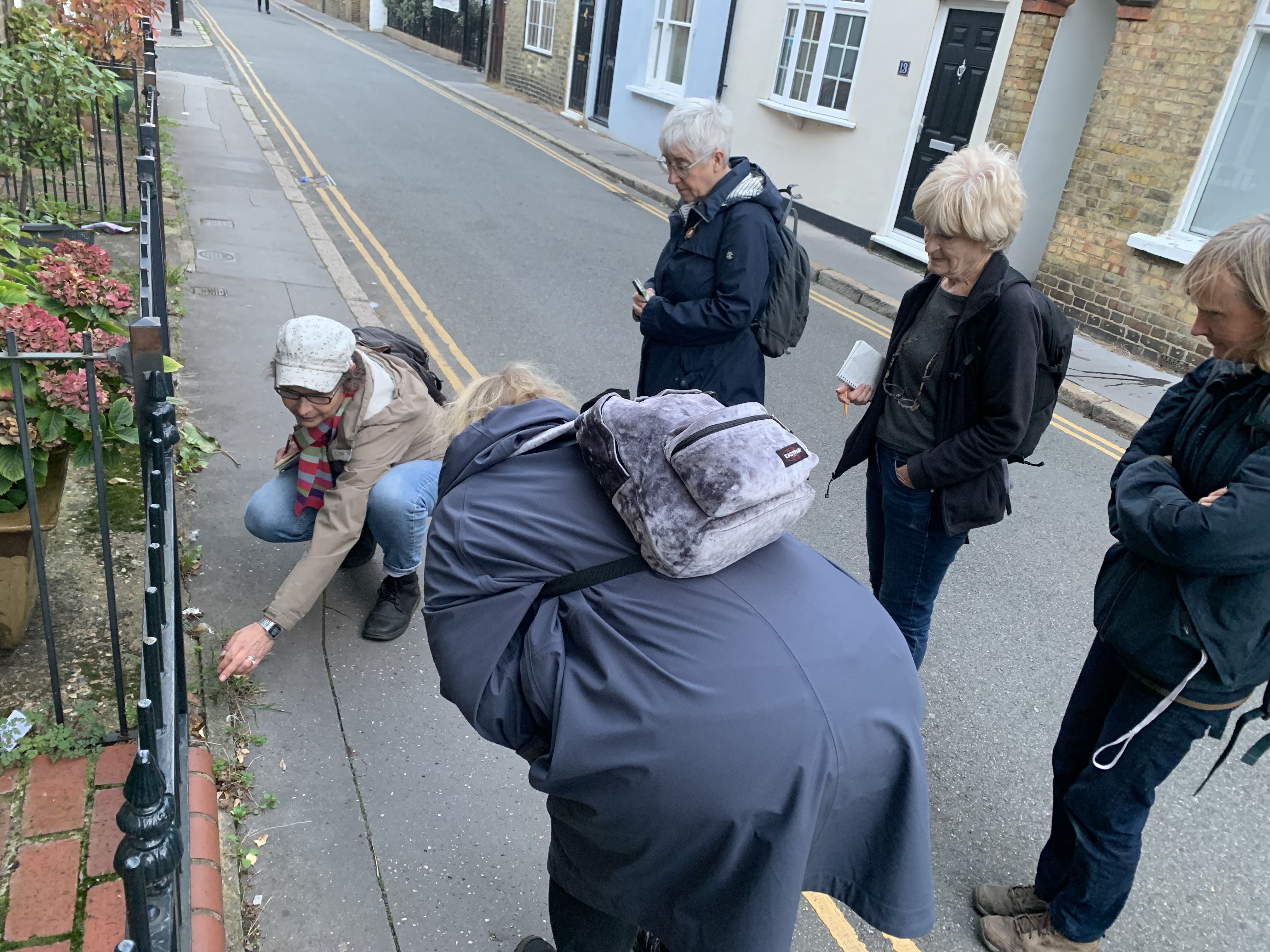
The pavements of the main drag of Crystal Palace triangle are plant free, I expect Croydon Council’s street-cleaning team have been at work here, so I’ve planned a route to poke around in some of the side alleys. We set off down what I think of as burger alley, past a patch of plastic grass – I roll out my Poa plastica joke – in front of the burger van, but beyond that we find cheerful yellow Oxford Ragwort (from Sicily), Pellitory-of-the-wall and a downy-grey sprig of Jersey Cudweed. This Cudweed is still on the Red List of protected plants despite being easy to find in South East London.
The Haynes Lane cul-de-sac pavement is edged with garden escapees like Purpletop Vervain and Lamb’s-ear and there are Mexican Fleabane and Greater Celandine flourishing behind a low wall. I show the group the four-lobed stigma of a Great Willowherb and tell them that I’ve read that Petty Spurge used to be used to treat skin cancer. We’re busy counting the stamens of Bittercress flowers – each flower seems to have four so is likely to be Wavy Bittercress – when a couple of young men come out of a café to ask, nicely, what we’re doing. They actually seem quite interested and point out a rogue tomato plant they’ve noticed growing up a wall.
In Ovett Close we find a lone Viper’s-bugloss flower with its forked stigma, Water Bent grass which I always think has flowering heads a little like Christmas trees and a healthy clump of Yellow Corydalis. We chat about the challenges of identifying dandelion-like plants when we find Autumn Hawkbit and Smooth Sowthistle, marvel at a front yard which is covered with Jersey Cudweed and finally come across a patch of Ivy-leaved Toadflax to end our walk.
In ninety minutes we’ve found 35 wild or naturalised plants in flower and identified a further 9 plants growing on the pavements of Crystal Palace. I can’t think of a nicer way to spend an autumn afternoon.
 The Urban Naturalist
A great wander with those 40+ sightings and IDs. The whole experience sounds joyous. Wish I were within range – I’d have learnt so much from walking those streets with your group. 🌿🌾🌸