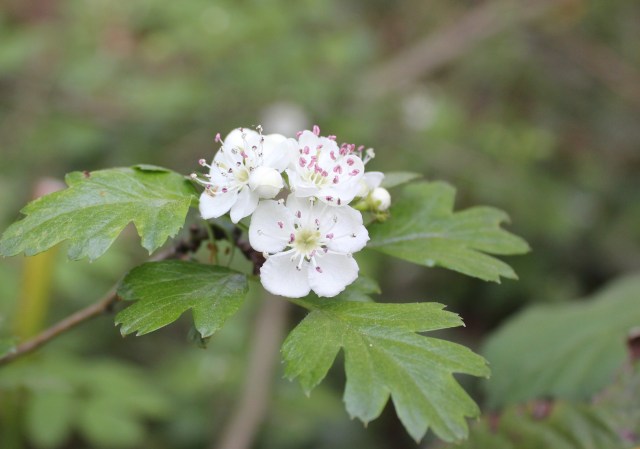
In the woods by the tunnel mouth, I bury my face in a spray of hawthorn blossom, and breathe in the sweet almondy scent. Apparently white from a distance, up close the five-petalled flowers have distinctly pink anthers. In this shady cutting, they positively glow.
It’s international dawn chorus day today. I didn’t organise myself to have an early start, but I like the idea of mass enjoyment of bird song. On the bench by the tunnel I shut my eyes and commune for a while.
Later I watch as a wren takes material to its nest just inside the tunnel mouth. He carries so much at a time that it’s hard to believe he can see clearly when he’s flying. Wrens are unusual among songbirds in that nest-building responsibility falls upon the male.
From the tunnel to the old tennis courts glade, along about a hundred metres of path, I hear what I believe to be ten separate wrens singing, which might indicate ten territories and ten nests in a fairly small area.
Is the density I’m very unscientifically estimating likely? Well wrens (Troglodytes troglodytes or cave-dweller) are the commonest breeding birds in the British Isles. In Stephen Moss’s biography of the wren, he says that the males are driven to keep singing even after they’ve found a mate to ward off interlopers.
While more common in the south, wrens breed all over these islands and there are also sub-species of wren, like the one on St Kilda archipelago fifty miles off the Outer Hebrides. I’ve always had a soft spot for wrens since I had the pleasure of sharing a barn with a wren family one summer on St Kilda. Every morning, the fledglings would wriggle out of the gap in the roof beams and then hop around the table where I was working.
One last sniff of sweet may blossom and then I’m ready to get on with my day.
 The Urban Naturalist