When I was a parent of small childen, a map of south east london would have featured playgrounds and child-friendly cafés. With children now grown and independent, I see the same area as an interconnecting set of green patches punctuated by local shops (which might still be selling vegetables).
Mapping is important for a number of animals. Pigeons have been seen to follow roads to reach home and researchers from the University of London have shown that buff-tailed bumblebees are able to map the most efficient route to travel from home to different nectar-rich flower patches.
Perhaps a place like the woods is best thought of as an overlaid set of maps, each one relating to a different organism’s perception.
For some species of solitary bees their maps will include unprepossessing bare areas of ground as well as flower patches. The soil needs to be the right consistency to enable them to dig their egg chambers.
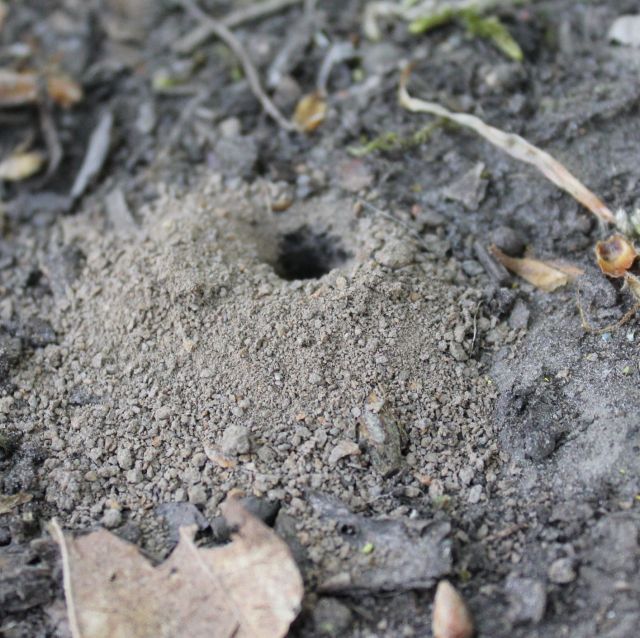
As a distant church bell rings, I methodically circle each tree looking for signs of mining. As I get my eye in, I spot tiny volcanoes surrounded by spoil heaps of recently excavated soil. For these small bees the effort this represents is unimaginable. Not surprising that individuals from some species share a burrow with separate egg chambers branching off it.
The disadvantage of a such a visible nesting site is vulnerability to parasitoid species. I read that bee flies are parasitoids of solitary bees. The flies deposit their eggs in the burrows so their larvae can make a meal of the bee larvae trapped inside.
 The Urban Naturalist