M joins me in the woods this morning. We walk and talk about family things but also notice the aftermath of the week’s rain and wind.
An oak tree is down, and has already been processed to clear the path. The dark stain of decay is clearly visible on one side of the sawn trunk.
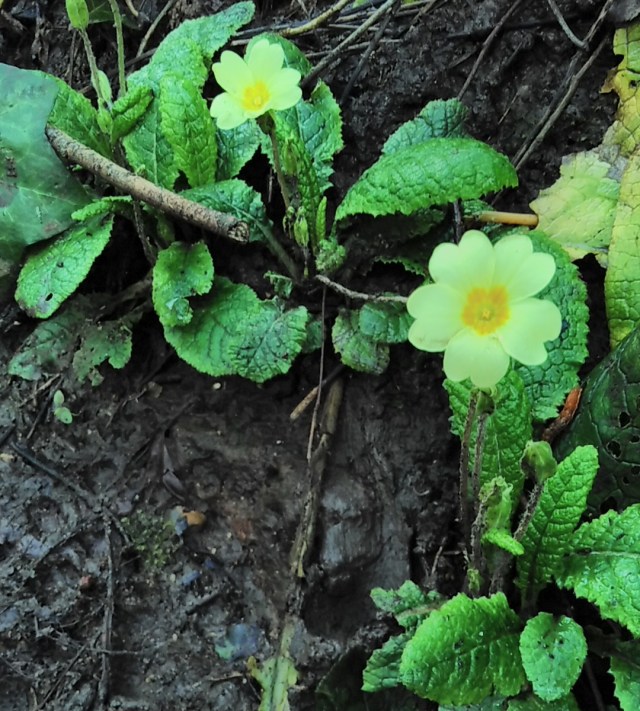
We find a patch of primroses in flower on a mud-churned bank. Primroses in our south-facing garden have been in flower for a few weeks now and were attracting bees this morning. These ones are slower to flower with a few hours less sunlight each day.
There are two types of primrose flowers, pin-eyed and thrum-eyed. Both have male anthers and a female stigma but the sex organs are arranged differently. This is to make sure pollen from a plant with pin-eyed flowers is most likely to pollinate a plant with thrum-eyed flowers and vice versa.
The plant we find has thrum-eyed flowers, the sexual parts having a fringed edge rather than a neat round pin shape.
Why “thrum-eyed” I wonder? On-line dictionaries define thrum as a low-level beating sound or to pluck a musical instrument. Might this be a reference to buzz pollination?
The other definition of thrum is to recite tiresomely and monotonously. I’m in danger of doing this in what I had imagined was regaling M with botanical details.
 The Urban Naturalist